Ada Lieb’s physical and mental disabilities almost forced her to leave the United States. Her family migrated from Russia to Nashville in 1922, where Ada found employment as a milliner thanks to her talent for needlework. Upon developing anxiety, numbness in one leg, and tremors in one hand resulting from childhood trauma, she transitioned to …
Category: Publications
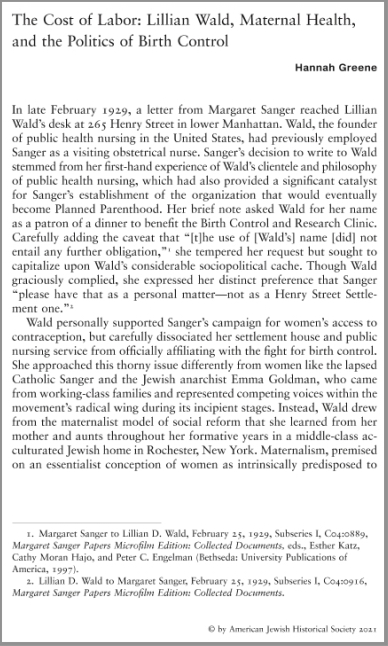
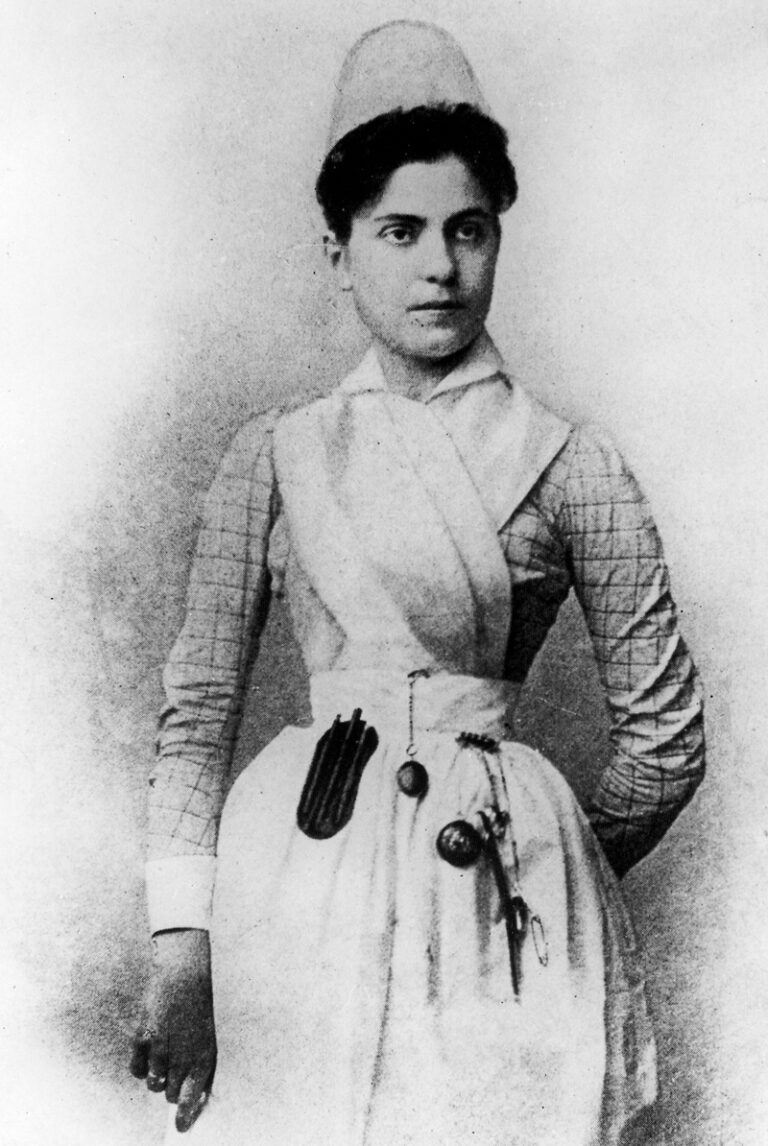
The Cost of Labor: Lillian Wald, Maternal Health, and the Politics of Birth Control
Hannah Zaves-Greene demonstrates how Wald’s middle-class Jewish background informed her advocacy for birth control and determined the rhetorical strategies she used to fight for its legality. When Wald argued that women needed contraceptives in order to become better mothers, she drew upon the maternalist sensibilities that offered Jewish women a path to respectability within the …
The Right to Choose: The Public Health and Birth Control Movements of Lillian Wald and Margaret Sanger
The story of America is the story of the unlikely groups of immigrants brought together by their shared outsider status. Urban American life took much of its shape from the arrival of Irish and Jewish immigrants in the nineteenth and twentieth centuries, and Forged in America is the story of how Irish America and Jewish …
Stuck in the Middle With(out) You: How American Immigration Law Trapped “Defective” Immigrants Between Two Worlds
The idea that at the beginning of the twentieth century, both political rhetoric and legal definition distinguished between immigrants who were “desirable” and those who were not, also looms large in Hannah Zaves-Greene’s essay… Zaves-Greene investigates one particular concept which was used to bar immigration, that of “public charge.” This idea held some immigrants were …
Defective Classifications: How American Jews Contested the Public Charge Policy in the Early Twentieth Century
The various elements of the U.S. government’s public charge policy methodically targeted ill, disabled, and impoverished immigrants for exclusion and deportation in order to socially engineer the United States population by “selecting” so-called “desirable” immigrants and “rejecting” those immigrants whom officials deemed “undesirable.” Gender and sex could also function as disabling “defects,” in the language …