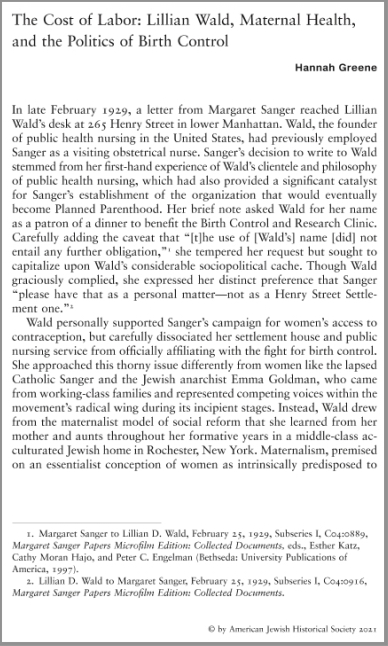
Hannah Zaves-Greene demonstrates how Wald’s middle-class Jewish background informed her advocacy for birth control and determined the rhetorical strategies she used to fight for its legality. When Wald argued that women needed contraceptives in order to become better mothers, she drew upon the maternalist sensibilities that offered Jewish women a path to respectability within the larger, Christian-dominated women’s movements of the early twentieth century. Wald harnessed these same maternalist principles to justify women’s involvement in an array of social welfare projects, as well as her own personal rejection of nuclear domesticity in favor of passionate same-sex relationships with other social reformers.