-
Journal article:
Defective Classifications: How American Jews Contested the Public Charge Policy in the Early Twentieth Century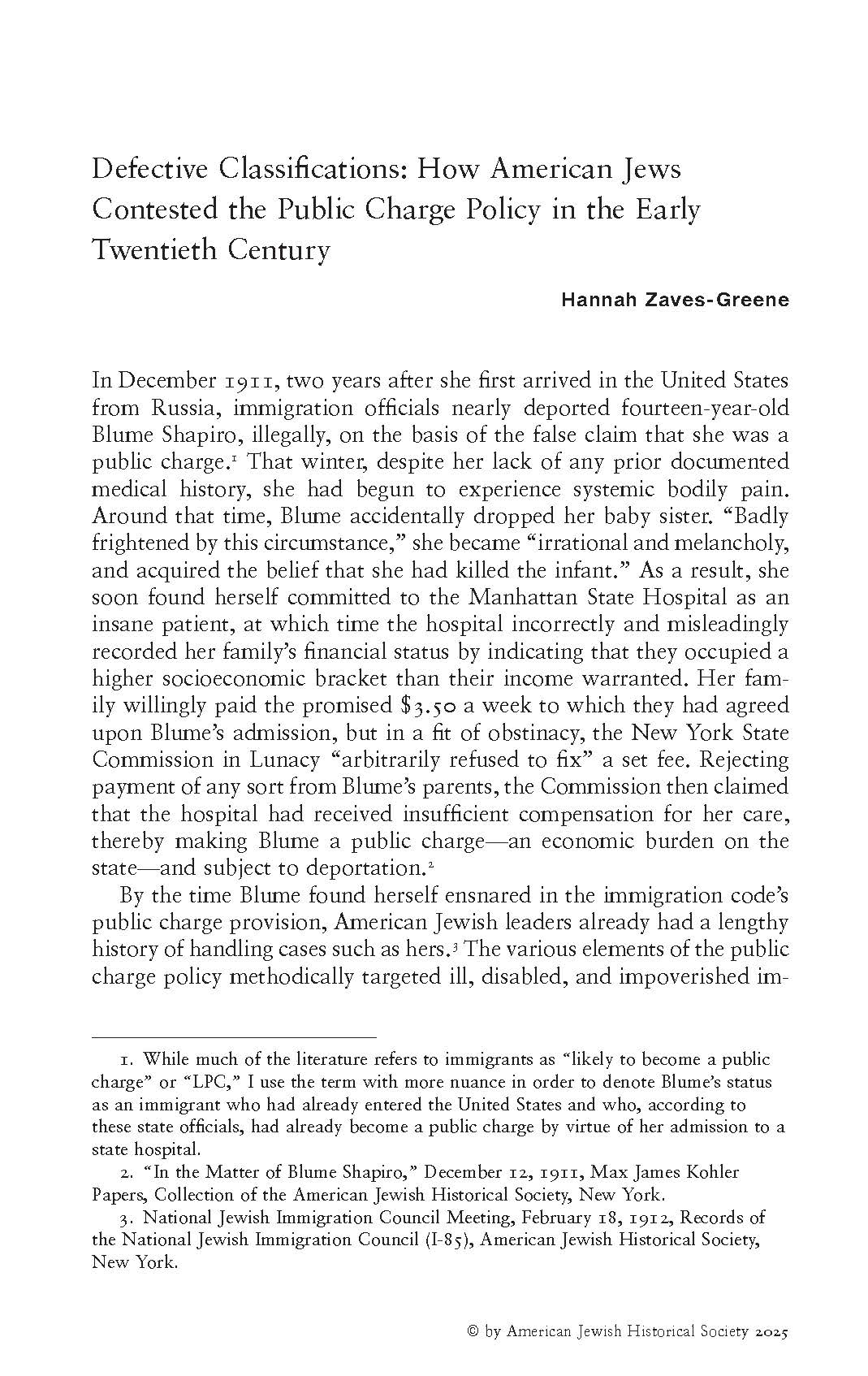
American Jewish History: Vol. 108, No. 1 (Jan. 2025 )
The various elements of the U.S. government’s public charge policy methodically targeted ill, disabled, and impoverished immigrants for exclusion and deportation in order to socially engineer the United States population by “selecting” so-called “desirable” immigrants and “rejecting” those immigrants whom officials deemed “undesirable.” Gender and sex could also function as disabling “defects,” in the language of the law, compounding the impediment that illness and impairment posed both to immigrants’ admission and continued residence in the United States. Collectively, these traits—subsumed within this central and mercurial category of “defect”—functioned to identify immigrants who would, according to the widespread and popular eugenic thought of the day, allegedly become a “burden” on the public and endanger the health and purity of the American “race.” But how to identify and define those traits, and their implications regarding prospective citizenship, was another matter entirely, and here immigration officials and American Jewish leaders fervently disagreed.
-
Journal article:
Stuck in the Middle With(out) You: How American Immigration Law Trapped “Defective” Immigrants Between Two Worlds
Journal of Transnational American Studies: Vol. 14, No. 2 (Nov. 2023)
The idea that at the beginning of the twentieth century, both political rhetoric and legal definition distinguished between immigrants who were “desirable” and those who were not, also looms large in Hannah Zaves-Greene’s essay… Zaves-Greene investigates one particular concept which was used to bar immigration, that of “public charge.” This idea held some immigrants were liable to become a “burden to the state,” and should hence be denied access to the US nation-state. Zaves-Greene follows one particular case in which the notion of “public charge” was applied to keep a young Jewish woman, Esther Kaplan, from becoming American. Having been classified as “mentally deficient,” Esther was seen as an “undesirable immigrant.” This charge was quickly challenged by Jewish American lawyers who sought to intervene into both the classification and the logic on which it was premised. Zaves-Greene thus weaves together concepts of early twentieth-century eugenics, disability, and immigration to show how the transnational and the medical were intimately connected. (Excerpted from introduction to special issue: Diagnosing Migrant Experience: Medical Humanities and Transnational American Studies)
-
Chapter in edited volume:
The Right to Choose: The Public Health and Birth Control Movements of Lillian Wald and Margaret Sanger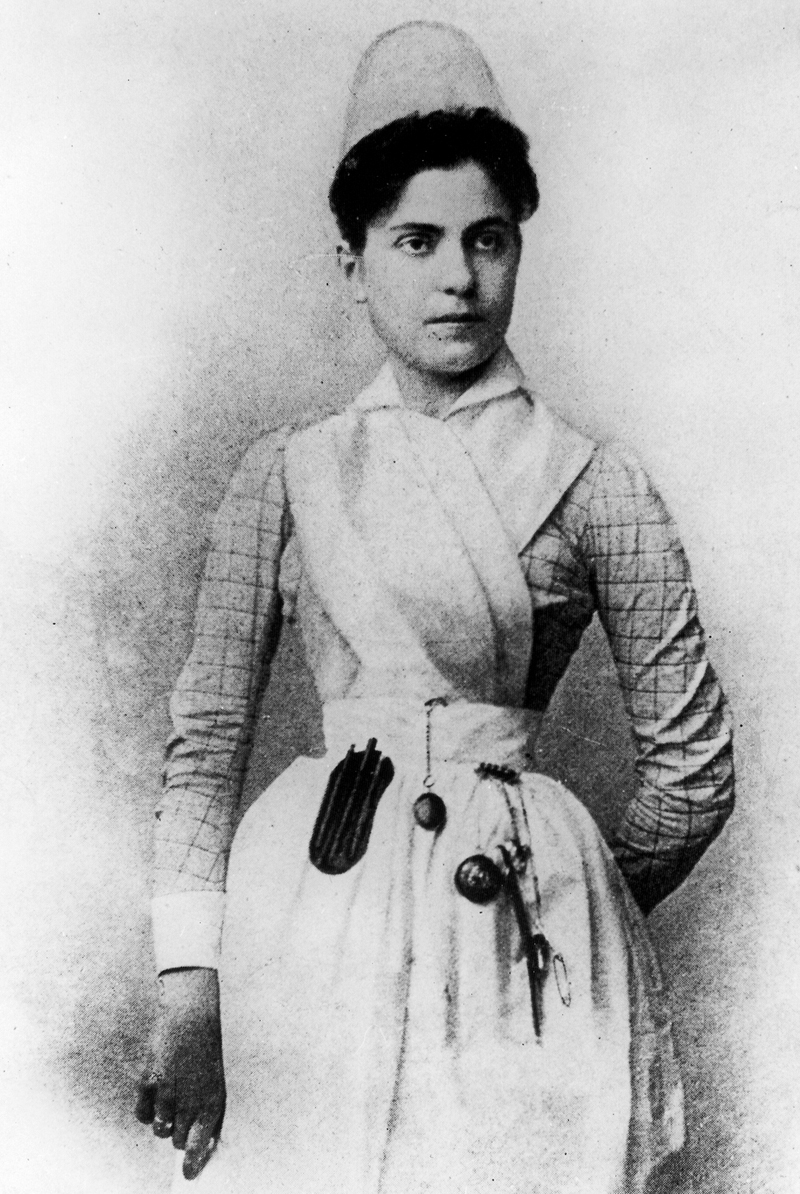
Forged in America: How Irish-Jewish Encounters Shaped a Nation ( Nov. 2023)
The story of America is the story of the unlikely groups of immigrants brought together by their shared outsider status. Urban American life took much of its shape from the arrival of Irish and Jewish immigrants in the nineteenth and twentieth centuries, and Forged in America is the story of how Irish America and Jewish America collided, cooperated, and collaborated in the cities where they made their homes, all the while shaping American identity and nationhood as we know it.
Bringing together leading scholars in their fields, this volume sheds light on the underexplored histories of Irish and Jewish collaboration. While mutual antagonism was clearly evident, so too were opportunities for cooperation, as settled Irish immigrants served to model, mentor, and mediate for Jewish newcomers. Together, the chapters in this volume draw fascinating portraits that show mutuality in action and demonstrate its cultural reverberations. (From publisher’s description)
-
Journal article:
The Cost of Labor: Lillian Wald, Maternal Health, and the Politics of Birth Control
American Jewish History: Vol. 104, No. 4 (Oct. 2020)
Hannah Zaves-Greene demonstrates how Wald’s middle-class Jewish background informed her advocacy for birth control and determined the rhetorical strategies she used to fight for its legality. When Wald argued that women needed contraceptives in order to become better mothers, she drew upon the maternalist sensibilities that offered Jewish women a path to respectability within the larger, Christian-dominated women’s movements of the early twentieth century. Wald harnessed these same maternalist principles to justify women’s involvement in an array of social welfare projects, as well as her own personal rejection of nuclear domesticity in favor of passionate same-sex relationships with other social reformers. (Excerpted from introduction to special issue: Sexuality in American Jewish History)
-
Journal article:
Who May Come to America?: Integrating Disability into Jewish Studies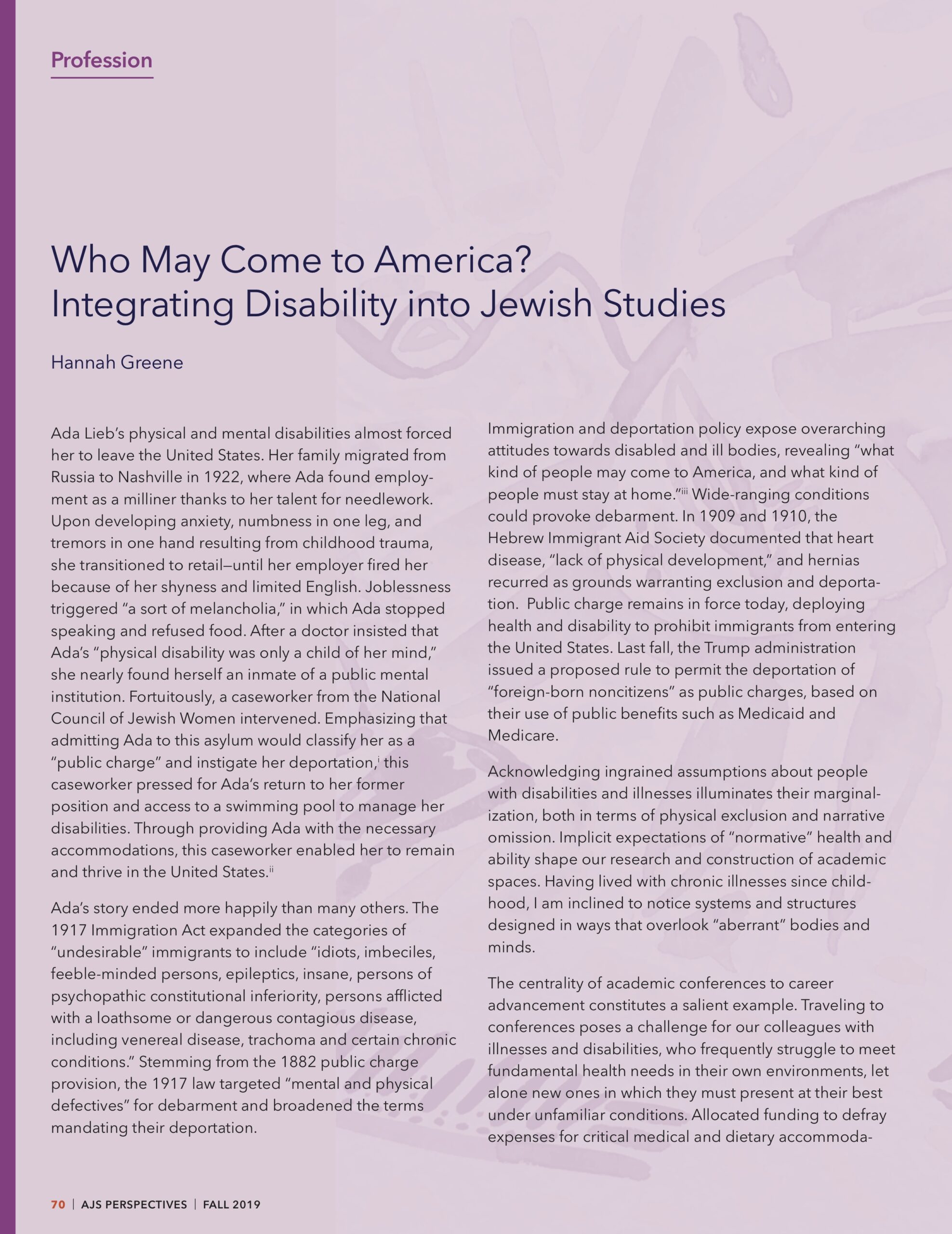
AJS Perspectives: “The Body Issue” (Fall 2019)
Ada Lieb’s physical and mental disabilities almost forced her to leave the United States. Her family migrated from Russia to Nashville in 1922, where Ada found employment as a milliner thanks to her talent for needlework. Upon developing anxiety, numbness in one leg, and tremors in one hand resulting from childhood trauma, she transitioned to retail—until her employer fired her because of her shyness and limited English. Joblessness triggered “a sort of melancholia,” in which Ada stopped speaking and refused food. After a doctor insisted that Ada’s “physical disability was only a child of her mind,” she nearly found herself an inmate of a public mental institution. Fortuitously, a caseworker from the National Council of Jewish Women intervened.

|
Hannah Zaves-Greene, Ph.DImmigration, disability, and belonging in the United States |